






Join the GenieLab Community
Receive regular updates and inspiration to help your business stay ahead of the game.
Need Assistance?
Contact US today It’s free – Click HERE.You may also like...

Thegenielab's First-Party Data Strategy for Shopify Plus
Key Highlights First-party data gives you stronger customer insights because it comes from direct data collection o...

How to Leverage Retail Media Networks for Your Store
Key Highlights Retail media networks let you turn your store into a digital advertising channel with valuable ad sp...

Setting Up Livestream Shopping with Thegenielab on Shopify
Key Highlights Livestream shopping blends live video, live chat, and online shopping into real time shopping events...

Exploring Conversational Commerce: Chat, SMS, and More
Key Highlights Conversational commerce turns chat apps, SMS, and voice tools into direct shopping channels. It im...

Customer Data Platform eCommerce for Your Shopify Store
Key Highlights A customer data platform pulls customer data from many tools into one place. An ecommerce CDP help...

Lifecycle Marketing: Connecting Loyalty, Email, and SMS
Lifecycle marketing treats loyalty, email, and SMS as one coordinated system triggered by real customer behavior — no...
Twitter Growth Strategies: Data-Backed Tips to Build Your Brand
It’s a common misconception that Twitter doesn’t deliver a meaningful return on investment. In reality, for small start-up businesses it can be an efficient, low-cost way to reach potential customers, test messaging, and steadily grow a brand. Used intentionally, Twitter supports discovery, conversation, and trust building—key drivers of engagement and retweets. The so-called “social media scientist” Dan Zarrella has studied what works on social platforms. He’s shared evidence-led Twitter growth strategies that both small start-ups and established brands can use to extend their reach on Twitter.
How can your brand stand out among the millions tweeting every day? Below are several of Zarrella’s most useful, testable Twitter growth strategies—originally shared on DanZarrella.com—reframed into practical tips you can apply. As you read, consider how each idea fits your audience and goals. What would you test first to validate ROI?
Use pictures to boost engagement and reach
Want your tweets to reach more people? Make sure you’re adding plenty of pictures. Research by Zarrella found that tweets with images increased retweets by up to 94%, which can amplify visibility and improve discovery. On a fast-moving feed, compelling visuals help your message stop the scroll, reinforce context, and invite clicks. That said, not all image links perform equally. Incorporating images from other social networks might expand your overall social footprint, but it appears to be a turn-off for retweets specifically. If your tweet includes a link to Instagram or Facebook, it will typically see 42% and 47% fewer retweets, respectively—suggesting native images are often the safer bet for retweet growth.
Reflective question: Are your most shared tweets native image posts, or do external image links dilute retweets for your audience?

Use clear calls to action to encourage retweets
As in other areas of marketing, a direct call to action can influence how users respond to your tweets. Zarrella’s work showed that explicit prompts correlate with more retweets. While tone and brand voice matter—“please help” or “please retweet” may not suit every message—there’s no doubt that including clear cues can increase visibility when used thoughtfully. Plain language like “retweet to share” or “join the conversation” can set expectations and nudge action without sounding pushy, especially when it aligns with helpful or newsworthy content.
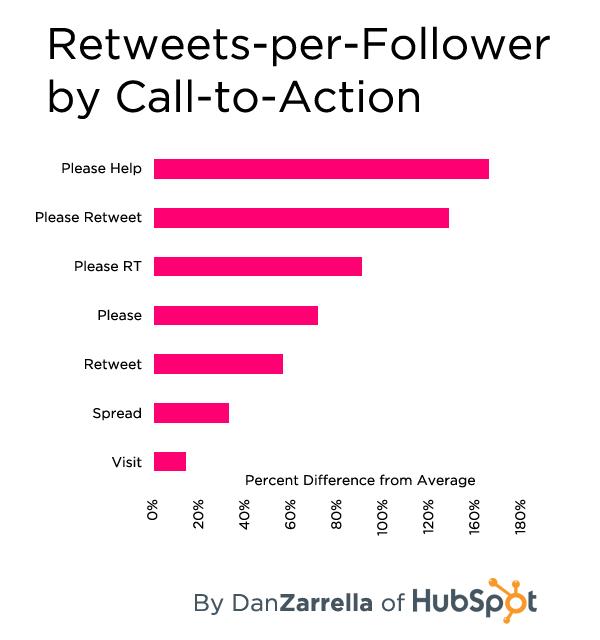
Reflective question: Where could a short, on-brand call to action naturally fit into your next tweet to increase engagement without disrupting its tone?
Get your character count right for optimum retweets
It’s well known that the character limit for a Twitter post is 140, but research suggests you may want to stop around 120. The chance of getting a retweet climbs steadily up to roughly 120 characters; beyond that, effectiveness tends to drop off. The sweet spot appears to sit between 100 and 115 characters—tweets in this range are about 34% more likely to be retweeted than others. In practice, that space lets you deliver a complete thought while leaving enough room for quoted retweets, increasing shareability without sacrificing clarity.

Reflective question: When you scan your recent posts, how many fall within the 100–115 character range designed for shareability?
Tweet at the weekends to increase engagement
Research has shown that people are about 17% more receptive to brands on Twitter at weekends. With fewer workday distractions, users may be more willing to browse, engage, and share. By contrast, Monday is often a weaker day for generating click-throughs. If you typically pause social activity on Saturdays and Sundays, consider scheduling a few test posts during those windows to see if your metrics lift. Small brands can benefit here, using weekend publishing to reach people when the feed is less crowded, attention is less fragmented, and engagement rises.

Reflective question: Do your weekend tweets show higher engagement or retweets compared to your weekday posting pattern?
…or tweet later in the day for stronger engagement and click-through rates
Morning tweeting is often a no-go—except during traditional commuting hours, when people are more likely to scroll and skim. In the afternoons, tweets tend to enjoy generally positive click-through rates, tapering off during the typical dinner window between 6 and 7 PM. These timing patterns can vary, but they’re useful baselines for planning Twitter growth. If your audience spans multiple time zones, test different afternoon slots and monitor which windows consistently deliver the best CTR and retweet volume.

Reflective question: Which time blocks—commute, mid-afternoon, or early evening—drive the most meaningful actions and engagement on your Twitter posts?
Use action words to drive clicks and shares
A classic copywriting rule is to include plenty of action words—especially verbs and adverbs—and the data indicates the same holds true on Twitter. Forceful, directional language correlates with stronger click-through rates, while tweets dominated by nouns and adjectives underperform. Clear, dynamic phrasing helps set expectations and communicates value quickly, encouraging readers to respond, click, or share. Small tweaks like front-loading a verb or tightening phrasing can noticeably impact performance across your Twitter growth strategies.

Reflective question: Can you rewrite your next tweet to lead with a verb and measure whether that change improves CTR and engagement?
Quick-start Checklist for Twitter Brand Growth
- Pair important announcements with a native image to invite retweets and boost engagement.
- Add a concise call to action (e.g., “retweet to share”) and engage by replying or retweeting quality user content.
- Aim for 100–115 characters to maximize retweet potential; use a quick poll when a short question fits.
- Define your audience and a clear goal for each tweet, then schedule weekend tests to compare engagement.
- Post during commute or mid-afternoon windows and track results in Twitter Analytics.
- Lead with verbs and front‑load keywords to keep tweets scannable and benefit-focused.
Most actionable today: publish with a native image, add a clear CTA, and post in one proven time block—then review performance and iterate.
Reflective question: Which single Twitter growth strategy will you test first to validate ROI?
A note on context, limitations, and your own data
Of course, none of this is absolute—your own social data should guide the final call. While these are useful pointers and may prove true for you, results vary by audience, industry, and offer; what grows your Twitter audience and engagement may differ from broad averages. If tracking your activity reveals patterns that contradict the averages, prioritize what your numbers show. The most reliable Twitter strategy is the one aligned with your customers, not a one-size-fits-all rule.
We’d love to hear about your experiences on Twitter! What strategies have you found most effective in growing your brand’s presence? Have you encountered any challenges, and how did you overcome them? Share your insights in the comments below or connect with us on Twitter—let’s learn from each other.
Conclusion: Turn insights into consistent Twitter ROI
Twitter can absolutely support brand growth—especially for small start-ups—when you pair data-backed tactics with steady testing. Use native images, clear calls to action, and action-driven language; keep copy within the 100–115 character sweet spot; and time posts for weekend and afternoon attention. Then, measure, iterate, and refine against your own benchmarks. Over time, these small improvements compound into stronger reach, engagement, and a clearer return.
If you’re looking for seamless social integration for your start-up brand, PHP Genie can help. Talk to us about how we can build a fully-responsive, engaging site today – call 01633 415 364 or email wish@thegenielab.com
