






Join the GenieLab Community
Receive regular updates and inspiration to help your business stay ahead of the game.
Need Assistance?
Contact US today It’s free – Click HERE.You may also like...

Magento to Shopify Migration Cost: A Realistic Breakdown
What a Magento to Shopify Migration Actually Costs There's no single number that applies to every Magento to Shopify ...

Multichannel Platform Migration Top 7 Safest Options
Safely scale revenue across channels by pairing the right platform with a disciplined plan. This multi-channel mig...

Shopify Plus Advanced Integrations: Connecting ERPs, CRMs, and Third-Party Systems
Drive Shopify Plus success by unifying ERP, CRM, and 3PL into one dependable data flow. Map SKUs, prices, and IDs; de...

How to Choose a Shopify Plus Migration Agency: The Complete Buyer’s Guide
Replatforming demands strategic planning, rigorous data integrity, SEO preservation, and near-zero downtime. Choose a...

How to Find an eCommerce Migration Agency That Won’t Tank Your SEO
Why Platform Migration Is an SEO Risk — and How to Manage It Every platform migration carries SEO risk. When you move...

Product Catalogue Migration to Shopify: Handling SKUs, Variants, and Custom Data
Key Highlights — Reduce downtime and data errors during product catalogue migration by using proven partners and clea...
Migrating From Magento Go: Your Options
As we blogged earlier this month:
- Magento announced the closure of Magento Go and ProStores, prompting urgent migration planning for merchants.
- Shutdown date: February 1st 2015.
- Approximately 10,000 small and mid-sized retailers will be affected worldwide.
- Magento, owned by eBay, acknowledged the difficulty of the decision and timed it so "customers could plan for it before the holidays."
What does that mean for store owners on Magento Go?
- Choose your next eCommerce software—Shopify, BigCommerce, Magento Enterprise/Community, or another fit.
- Migrate eCommerce store data, design, and operations with a clear plan and timeline.
- Leverage migration strategies across cloud-based eCommerce platforms to keep sales moving.
Understanding eCommerce Migration and eCommerce Hosting Options
- Magento: an open-source eCommerce platform available in several editions. Magento Go was the simpler, hosted version for small merchants; Community and Enterprise are self-hosted with greater customization and scalability for teams with technical resources.
- Shopify: a fully hosted, cloud-based platform that emphasizes ease of use and fast setup, extended through a large app ecosystem.
- BigCommerce: a comparable cloud-based solution offering comprehensive features, built-in marketing tools, and scalability without managing servers.
Providing clear definitions builds credibility and helps readers compare options with confidence, grounding recommendations in an accurate understanding of each platform's strengths and limits.
Types of Platforms to Consider for Online Store Migration
Every Magento Go merchant effectively has three strategic choices.
- Evaluate routes for migrating online stores: self-hosted Magento Enterprise/Community versus hosted platforms like Shopify or BigCommerce.
- Consider each option's strengths, limitations, costs, and time-to-launch before committing.
Option 1: Transition to Magento Enterprise or Community (self-hosted)
Magento hopes some businesses will upgrade to its Enterprise or Community editions. These options deliver deeper customization, advanced catalog capabilities, and integration flexibility. However, they are notably more expensive than Magento Go. While pricing is bespoke and varies by project, a typical business could expect to pay roughly $15,000 more per annum on Enterprise and Community once licensing, hosting, and development are factored in.
- Pros: maximum control, robust feature set, extensive extensions, and long-term scalability.
- Cons: higher total cost of ownership, increased technical complexity, and a longer implementation timeline.
- Best for: established retailers with dedicated budgets and in-house or agency development support.
Option 2: Migrate to BigCommerce (hosted eCommerce platform)
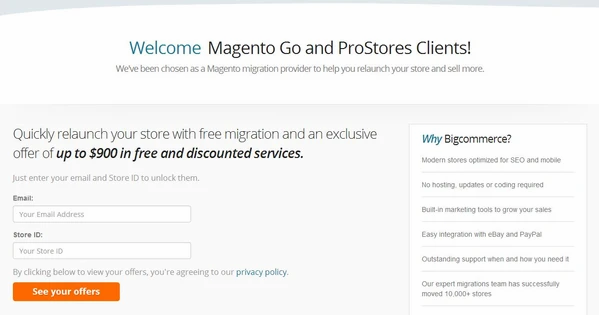
Magento recognizes that many smaller businesses won't move to a more complex, self-hosted stack. During the wind-down period, Magento struck a deal with BigCommerce to transition many Go customers. Steven Power, President of BigCommerce, estimates that half of BigCommerce's 12,000 total migrated clients have come from ProStores and Magento Go, and he expects a significant share of the remaining 10,000 Magento Go stores to choose BigCommerce.
To encourage adoption, BigCommerce promoted exclusive offers for Go clients. However, while it mentions $900 of discounts, the breakdown appears only after submitting details.
- Pros: cloud-based eCommerce solution with strong built-in marketing tools, straightforward setup, and no server maintenance.
- Cons: unclear discount specifics without registration and potentially limited customization versus self-hosted Magento.
- Best for: merchants seeking speed, simplicity, and a hosted platform with room to grow.
Option 3: Migrate to Shopify (hosted eCommerce platform)
Shopify is not an official transition partner, but it is actively courting Magento Go merchants with more concrete offers:
- 10% discount on its plans
- Free transfer from Magento Go
- A one-hour call with an ecommerce expert at Shopify
- A free 14-day trial
Shopify's cloud-based eCommerce model reduces technical overhead, and its app store, themes, and payment integrations make it attractive for fast, low-friction launches. For many SMBs, that simplicity and clear incentives are compelling.
- Pros: quick to launch, transparent incentives, intuitive admin, and a large ecosystem of apps and themes.
- Cons: app costs can add up, and some advanced customizations may require workarounds or expert help.
- Best for: retailers prioritizing speed, usability, and a predictable hosted environment.

What Magento Go's Closure Means for Retailers
Magento Go's shutdown is disruptive, but it can also be a turning point. The platform underperformed against hosted leaders like Shopify and BigCommerce, where merchants favored ease of use and built-in growth features. In effect, the market spoke with its feet. For many, the transition from Magento Go is an opportunity to relaunch on a platform better aligned with their needs—whether that's full control with Magento Enterprise/Community or a streamlined hosted solution.
Step-by-Step Migration Process from Magento Go
- Inventory your store—products, categories, attributes, customers, orders, content, and URL structure—to migrate eCommerce store efficiently.
- Prioritize data fidelity: ensure products, images, and customer records map cleanly to your new platform.
- Handle store design migration: decide whether to port your brand styling or leverage a new theme for improved UX.
- Preserve SEO during migration: set up 301 redirects, migrate meta content, and maintain your URL strategy where possible.
- Test functionality: confirm payments, shipping rules, taxes, discounts, and transactional emails before launch.
- Schedule cutover wisely: choose a low-traffic window and communicate clearly with customers.
- Monitor post-launch: track analytics, conversion rates, and error logs; fix issues quickly.
After considering these steps, which migration path feels most aligned with your goals—greater customization on Magento Enterprise/Community or a faster, hosted route with Shopify or BigCommerce?
Evaluating Your Migration Choices: Platform Comparison
The good news: there are many capable options among the best eCommerce platforms today. If you are leaving Magento Go, you can move to a solution with stronger conversion tools, better marketing options, cleaner back-end workflows, and modern storefront designs that can help increase revenue. Explore your eCommerce solutions landscape and shortlist choices that balance features, costs, and time to value.
The bad news: you do need to choose—and soon. Deciding whether Shopify, BigCommerce, or another provider is the right fit takes honest evaluation of budget, timeline, and resources. The upside is that a structured migration plan reduces risk and helps you relaunch with confidence.
Shopify vs. Magento vs. BigCommerce: Which option would you pick?
What matters most for your store right now—speed to launch, long-term flexibility, or total cost of ownership? How comfortable are you with managing technical complexity versus relying on a hosted provider as you choose eCommerce software?
Conclusion: Making Your Migration Decision
Migrating from Magento Go requires a clear decision between customizable power (Magento Enterprise/Community) and hosted simplicity (Shopify or BigCommerce). Each route has trade-offs: control and extensibility versus speed and ease. Bottom line: migration can protect revenue, improve your storefront, and position your business for growth—so start now to meet the February 1st 2015 shutdown.
If you'd like expert help evaluating platforms, mapping data, preserving SEO, and executing a clean cutover, we're here to assist. To discuss your ecommerce needs and how we can help, give us a call today on +1 305-762-0130 (US) or (UK) +44 (0) 2920 837 438.
(Image: Serge Melki under CC BY 2.0)
Evaluating your migration from Magento Go? Visit our Shopify migration service page to see how TheGenieLab handles platform moves from legacy eCommerce systems to Shopify.
